
Child Height Predictor Calculator – Predict Your Child’s Adult Height
Estimate how tall your son or daughter will grow using two science-backed methods — the same approaches used by paediatricians worldwide. Instant results, no sign-up required.

Child Height Predictor
Choose a prediction method below
Uses the mid-parental height method. Results are estimates with a typical range of ±4 in (10 cm). Genetics, nutrition, and health also play a role.
The Khamis-Roche method (1994) is one of the most accurate non-radiographic height prediction methods for children aged 4–17. Accuracy may vary for atypical body compositions.
What Is a Child Height Predictor Calculator?
A child height predictor calculator is a tool that estimates the adult height your son or daughter is likely to reach, based on the heights of both biological parents — and, in more advanced methods, the child’s current height, weight, and age. Our calculator offers two science-backed approaches: the mid-parental height (MPH) method and the Khamis-Roche method, which is one of the most accurate non-radiographic predictors available for children aged 4–17.
Whether you are curious about how tall your boy will be or want to track whether your daughter is growing on her expected curve, these methods give you an evidence-based starting point grounded in genetics and paediatric research.
How Does the Mid-Parental Height Calculator Work?
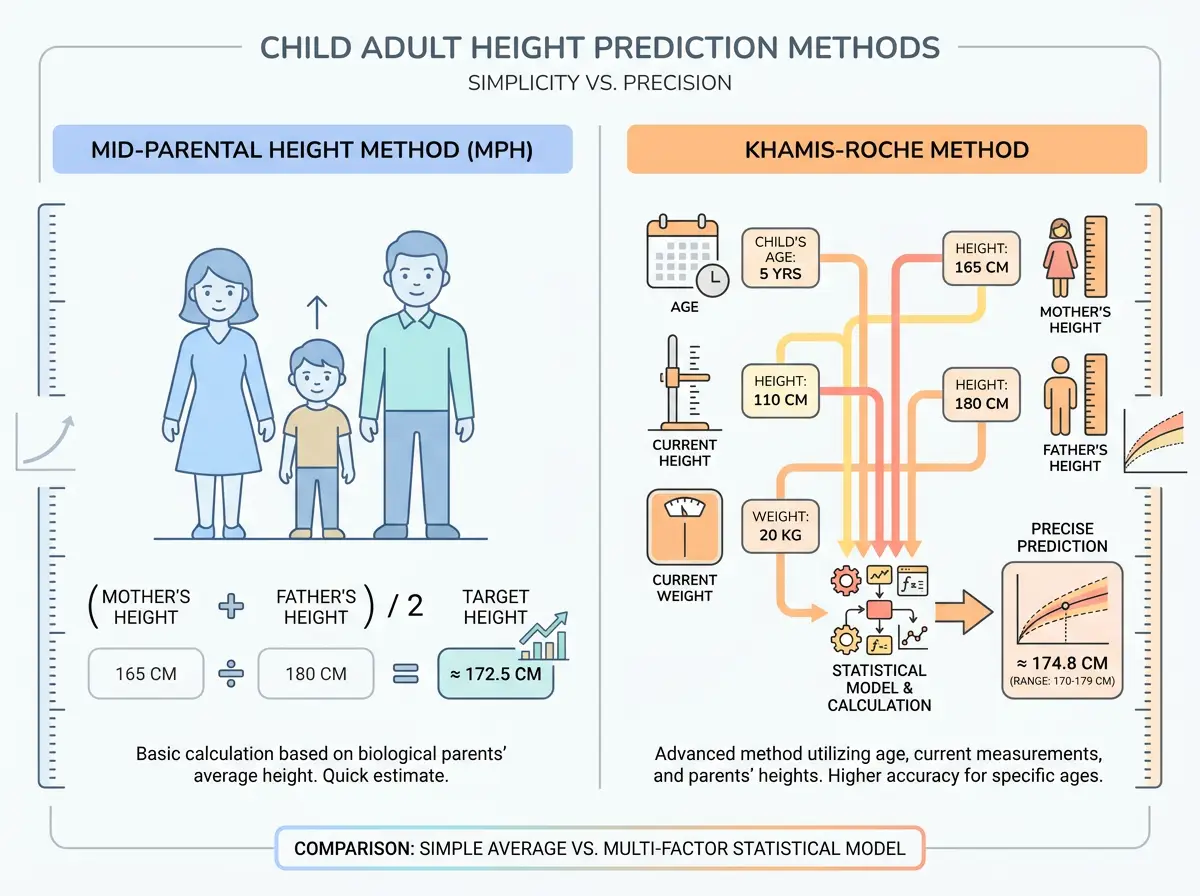
The mid-parental height formula works by averaging the parents’ heights and applying a sex-specific correction to account for the average height difference between men and women — approximately 5 inches (13 cm). This method has been part of standard paediatric growth assessment for decades and is the quickest way to estimate a child’s adult height without any clinical measurements.
The Formula Explained
For girls: (Mother’s height + Father’s height − 5 in) ÷ 2
In centimetres —
Boys: (Mother cm + Father cm + 13 cm) ÷ 2
Girls: (Mother cm + Father cm − 13 cm) ÷ 2
The resulting figure is the target height. The standard deviation is approximately 2 inches (5 cm), meaning 95% of children from these parents fall within ±2 inches of the predicted value. Our calculator also shows the broader typical ±4-inch range that reflects everyday real-world variation.
Mother: 5 ft 4 in (64 in). Father: 5 ft 10 in (70 in). Predicting for a boy: (64 + 70 + 5) ÷ 2 = 69.5 inches (5 ft 9.5 in). Normal range: 5 ft 7.5 in to 5 ft 11.5 in.
Why Parents Use This Method
The mid-parental height method is popular because it is quick, easy, and requires only two pieces of information: the biological parents’ heights. It is commonly discussed in paediatric growth appointments and can even be used before a child is born to estimate how tall they might grow.
- Quick and easy to calculate with no child measurements needed
- Can estimate adult height even before birth
- Commonly used in paediatric growth discussions
- Provides a reliable genetic baseline estimate
Limitations of the Mid-Parental Method
Although useful, the mid-parental method does not take into account the child’s current height, weight, growth percentile, puberty timing, or lifestyle factors. For this reason, the result should be considered a general estimate rather than an exact prediction.
What Is the Khamis-Roche Method?
The Khamis-Roche method (1994) uses regression equations from a large longitudinal US study to predict adult height from a child’s current height, weight, age, and mid-parental height. It is widely regarded as one of the most accurate height prediction tools that doesn’t require a bone age X-ray.
It is validated for children aged 4 to 17 and produces a standard error of estimate (SEE) — typically under 2.5 inches — that reflects the precision of the prediction at that specific age. Predictions for teenagers are more precise as less growing remains.
Why the Khamis-Roche Method Is More Advanced
The Khamis-Roche method uses a child’s current growth measurements — alongside parental heights — to provide a more personalised prediction. Many growth specialists consider it one of the most reliable methods for estimating adult height without the need for medical imaging such as a bone age X-ray.
How Accurate Is the Khamis-Roche Method?
The standard error of estimate shown in our calculator tells you how wide the uncertainty range is at your child’s specific age. Younger children have a wider range; predictions for teenagers close to their full height are notably more precise. As always, actual growth can still vary due to genetics, hormones, medical conditions, nutrition, and puberty timing.
Which Height Prediction Method Is Better?
Both methods have their place. The best choice depends on what information you have available and how much precision you need.
| Feature | Mid-Parental Method | Khamis-Roche Method |
|---|---|---|
| Inputs required | Parents’ heights only | Child’s age, height, weight + parents’ heights |
| Usable before birth | ✓ Yes | ✗ No |
| Valid age range | Any age | 4–17 years only |
| Typical accuracy | ±2 in (5 cm) for 95% | SEE under 2.5 in (6.4 cm) |
| Uses child’s current growth | ✗ No | ✓ Yes |
| Best for | Quick estimates, prenatal planning | Detailed predictions for growing children |
Many parents find it helpful to compare results from both methods to gain a broader understanding of their child’s possible adult height range.
How to Predict Your Child’s Adult Height: Step by Step
You can use our calculator above for instant results. If you want to work through the mid-parental method manually, follow these four steps:
- Convert both parents’ heights to the same unitUse either inches or centimetres throughout — do not mix units.
- Add the mother’s and father’s heights togetherSimply add the two figures to get a combined total.
- Apply the sex-specific correctionFor a boy: add 5 inches (13 cm). For a girl: subtract 5 inches (13 cm).
- Divide by 2This is the mid-parental target height. The normal range is this figure ±2 inches (±5 cm).
For the Khamis-Roche method, you also need the child’s current height, weight, and age — enter these into Method 2 of the calculator above for a more precise prediction.
How Tall Will My Boy Be?
When parents ask “how tall will my boy be?”, the mid-parental height formula is the most practical first answer. Enter both parents’ heights into our calculator above to get an instant prediction with a percentile comparison.
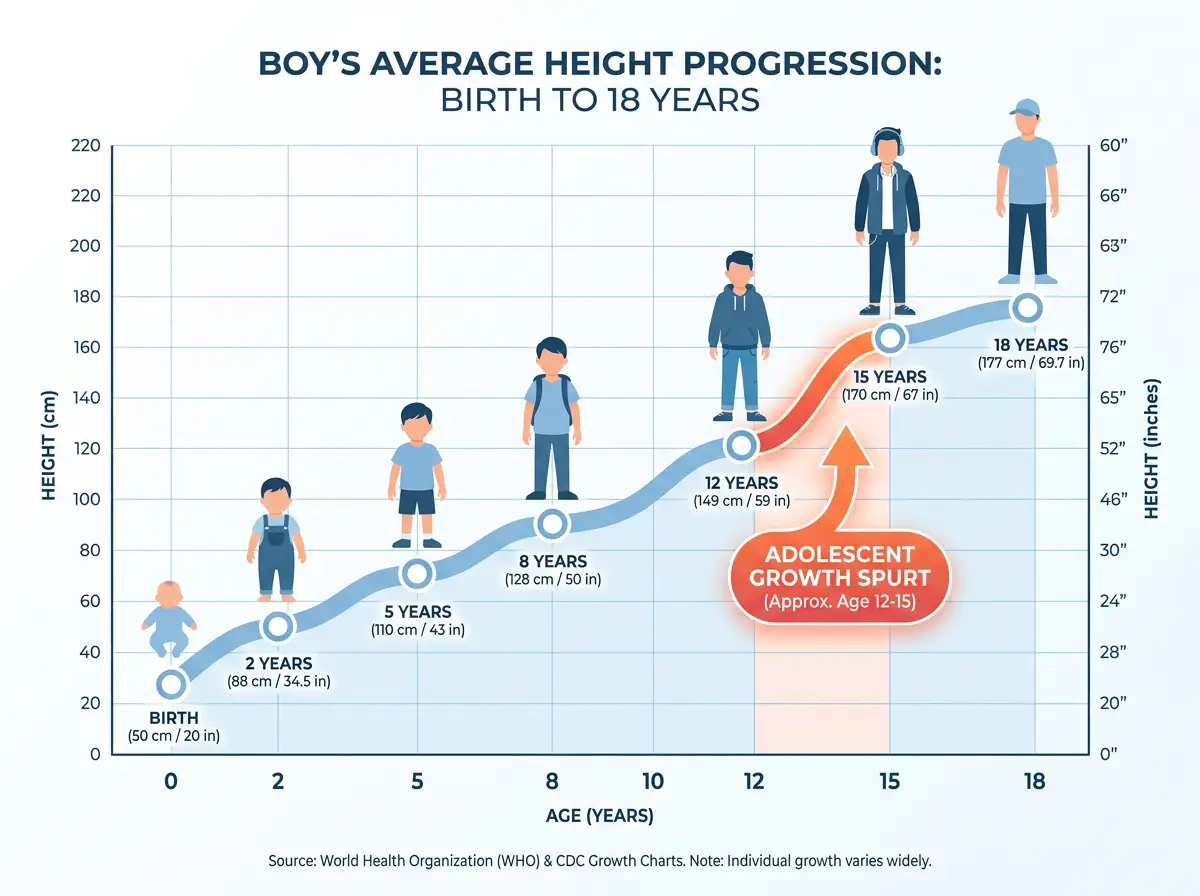
Boys typically experience their main growth spurt between ages 12 and 15 — later than girls. During this period, some boys can grow 3–4 inches in a single year. Growth then slows considerably and most boys reach their final adult height between ages 16 and 18.
Beyond genetics, a son’s final height is influenced by nutrition (especially protein and zinc during puberty), sleep quality, physical activity, and general health. Boys who experience a chronic illness or nutritional deficiency during key growth windows may not reach their full genetic potential.
When Do Boys Stop Growing?
Most boys stop growing between the ages of 16 and 18, once puberty is complete and the growth plates in the long bones close. Some young men continue to gain a small amount of height — sometimes half an inch to an inch — into their early twenties, but significant growth after 18 is uncommon.
During puberty, boys experience rapid changes beyond height: shoulders broaden, muscle mass increases, and the voice deepens. These changes typically begin between ages 11 and 14 and are mostly complete by age 17–18. Once the growth plates close, no further increase in height is possible.
If your son appears to have stopped growing significantly before age 16, or if he has not started puberty by age 14, it is worth speaking with your GP.
How Tall Will My Girl Be?
For daughters, the same mid-parental height method applies using the subtraction formula. Enter both parents’ heights into our calculator above to get your daughter’s predicted adult height and see where it falls on the percentile scale.
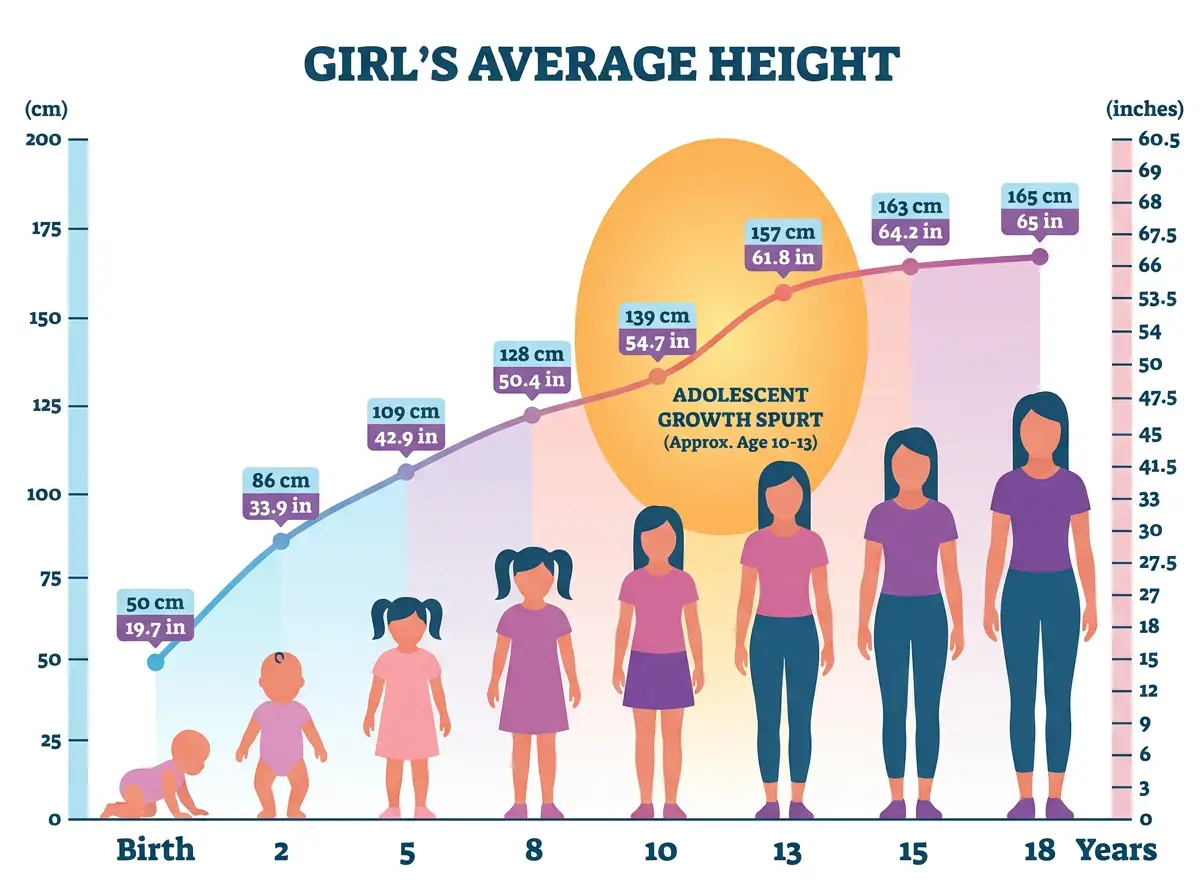
Girls typically grow fastest between ages 10 and 13, before or shortly after puberty begins. During the peak growth year, girls can gain 2–3 inches in height. Growth then slows significantly and most girls reach their final adult height by age 14–16 — usually within two years of their first menstrual period.
Girls who experience early puberty (before age 8–9) sometimes end up shorter than predicted because the early oestrogen surge can close the growth plates prematurely, cutting short the growing window. Conversely, girls who mature late may continue growing for longer and tend to hit the upper end of their predicted range.
When Do Girls Stop Growing?
Girls generally stop growing earlier than boys. Most girls reach their adult height between the ages of 14 and 16, which corresponds roughly to two years after their first period. The largest growth spurt typically occurs just before or shortly after puberty begins — often around age 11–12.
Because girls enter puberty earlier than boys, they also tend to reach their final adult height sooner. A girl who is the tallest in her class at age 11 may find that her male classmates overtake her height by age 15–16 as they go through their later, larger growth spurt.
If your daughter has not shown any signs of puberty by age 13, or appears to have stopped growing significantly before age 14, consult your GP.
Average Height by Age for Boys and Girls
The table below shows average heights at key ages according to UK and US reference data. Use this alongside your child’s predicted adult height to see whether your child is currently tracking above, at, or below the average for their age.
| Age | Average — Boys | Average — Girls |
|---|---|---|
| 2 years | 86 cm / 2 ft 10 in | 85 cm / 2 ft 9 in |
| 4 years | 102 cm / 3 ft 4 in | 101 cm / 3 ft 4 in |
| 6 years | 116 cm / 3 ft 10 in | 115 cm / 3 ft 9 in |
| 8 years | 128 cm / 4 ft 2 in | 128 cm / 4 ft 2 in |
| 10 years | 138 cm / 4 ft 6 in | 140 cm / 4 ft 7 in |
| 12 years | 149 cm / 4 ft 11 in | 152 cm / 5 ft 0 in |
| 14 years | 163 cm / 5 ft 4 in | 160 cm / 5 ft 3 in |
| 16 years | 174 cm / 5 ft 9 in | 162 cm / 5 ft 4 in |
| Adult | 175–177 cm / 5 ft 9 in | 161–163 cm / 5 ft 4 in |
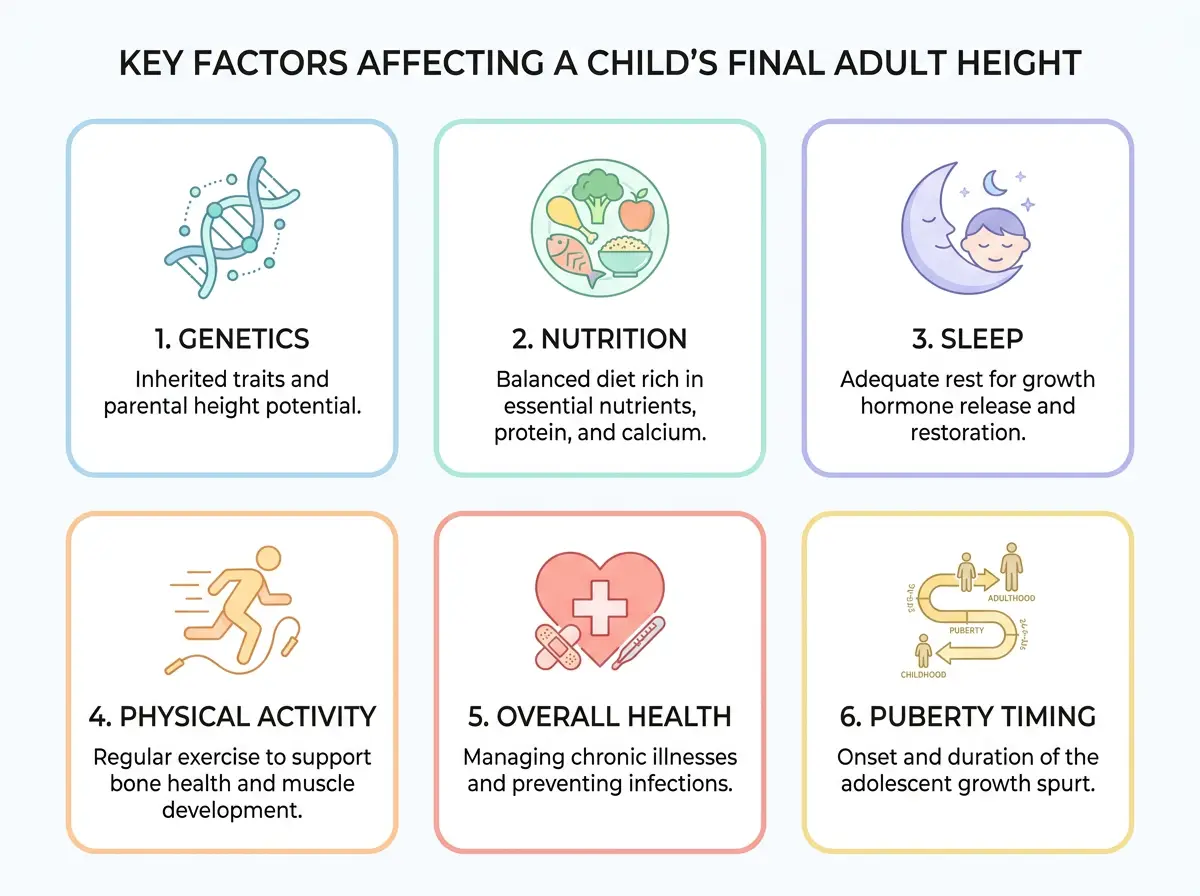
Factors That Affect Your Child’s Final Height
While genetics sets the upper limit for height, several environmental and lifestyle factors determine how close a child gets to that ceiling.
Genetics (60–80%)
Over 700 genetic variants influence height. Parental height is the single best proxy for a child’s genetic potential — exactly what our calculator captures.
Nutrition
Protein, calcium, zinc, and vitamin D are essential during growth years. Severe under-nutrition in early childhood can cause stunting that is difficult to reverse.
Sleep
Growth hormone is primarily secreted during slow-wave sleep. Children who consistently under-sleep may have lower growth hormone output.
Physical Activity
Moderate weight-bearing exercise stimulates bone growth. However, extreme training in young girls has been linked to reduced final height.
Health Conditions
Coeliac disease, IBD, thyroid disorders, and growth hormone deficiency can all impair growth. Early treatment usually limits long-term height impact.
Puberty Timing
Early maturers may end up shorter due to earlier growth plate closure. Late developers often reach the upper end of their predicted range.
Understanding Growth Percentiles
Doctors use growth percentiles to compare a child’s height with that of other children of the same age and sex. Our calculator shows where the predicted adult height falls on the percentile scale relative to the general adult population.
- 50th percentile — average height for the population
- 75th percentile — taller than 75% of children of the same age and sex
- 25th percentile — shorter than 75% of children of the same age and sex
- Below the 2nd percentile — worth discussing with a GP or paediatrician
Being shorter or taller than average does not automatically indicate a health problem. What matters more than the percentile itself is whether a child is growing consistently along their centile curve over time — which is why tracking growth at regular intervals is more informative than a single measurement.
Child Height Predictor vs Growth Charts
A child height predictor calculator and a growth chart serve different but complementary purposes. Growth charts track a child’s current height against age-matched peers; the mid-parental height calculator and Khamis-Roche method estimate final adult height.
Paediatricians use both together: growth charts show whether a child is growing consistently along their centile curve, while the height prediction tells them whether that centile is appropriate for their family background. A child growing consistently on the 9th centile whose parents are both short may be perfectly healthy; the same centile in a child of tall parents might warrant closer investigation.
Limitations of a Child Height Predictor Calculator
These calculators are best used as educational tools and should not replace professional medical advice. Key limitations to keep in mind:
- Does not account for non-paternity or adoption, where genetic links differ from assumed ones.
- Assumes parents grew to their genetic potential — parents who were malnourished as children may be shorter than their genes intended.
- The Khamis-Roche method was validated on a US population and may be slightly less precise for children from other ethnic backgrounds.
- Cannot account for de novo mutations or rare genetic conditions that affect height independently of parental heights.
- For children with a known growth disorder, clinical growth charts and bone age X-rays are more informative.
- Accuracy generally improves as children grow older and less growth remains.
When to Consult a Doctor
While most variation in child height is entirely normal, there are situations where it is worth seeking professional advice:
Your child’s height is consistently below the 2nd percentile on growth charts · They have stopped growing for more than 6 months before puberty is complete · They are growing significantly outside their mid-parental height range · Your son has not started puberty by age 14 or your daughter by age 13 · You notice a sudden and unexplained slowdown in growth rate.
If your child has a known growth hormone deficiency, Turner syndrome, or another condition affecting growth, this calculator is not a substitute for clinical assessment. A paediatric endocrinologist can use bone age X-rays and hormone testing for a far more precise and personalised prediction.
Frequently Asked Questions
Answers to the most common questions about predicting your child’s adult height.
How accurate is a child height predictor calculator?
What is the mid-parental height formula?
How tall will my boy be?
How tall will my girl be?
At what age do boys stop growing?
At what age do girls stop growing?
What is the Khamis-Roche method?
Can nutrition affect my child’s predicted height?
Is this calculator suitable for children with a growth disorder?
Can I use this calculator if my child is adopted?
References & Further Reading
- Tanner JM, Goldstein H, Whitehouse RH. “Standards for children’s height at ages 2–9 years allowing for height of parents.” Archives of Disease in Childhood, 1970.
- Khamis HJ, Roche AF. “Predicting adult stature without using skeletal age: the Khamis-Roche method.” Pediatrics, 1994;94(4):504–7.
- Luo ZC, Albertsson-Wikland K, Karlberg J. “Target height as predicted by parental heights in a population-based study.” Pediatric Research, 1998;44(4):563–71.
- Silventoinen K et al. “Heritability of adult body height: a comparative study of twin cohorts in eight countries.” Twin Research, 2003;6(5):399–408.
- NHS UK — Growth problems in children.
- CDC Growth Charts — cdc.gov/growthcharts.
- RCPCH UK-WHO Growth Charts — rcpch.ac.uk/resources/growth-charts.