
5 Year Old Milestones UK: Complete Guide for Parents
Everything you need to know about developmental milestones for 5 year olds — physical, language, social and cognitive — with reference to NHS guidance.
- 1.What Are Developmental Milestones?
- 2.Physical Development at Age 5
- 3.Communication & Language
- 4.Social & Emotional Development
- 5.Cognitive Development
- 6.↳ Free Milestone Checker
- 7.School Readiness at Age 5
- 8.The Reception Year in the UK
- 9.How to Encourage Development
- 10.When to Speak to Your GP
- 11.Frequently Asked Questions
Your child’s fifth birthday marks one of the most significant transitions of their early life — starting school. Between the ages of four and five, children in England, Scotland, Wales and Northern Ireland enter Reception or Primary 1, beginning a journey that will shape their learning for years to come.
If you’ve been searching for 5 year old milestones UK guidance — or wondering what should a 5 year old be able to do before or during their first year at school — you’re in the right place. This guide covers everything across all areas of development, with reference to NHS guidance and the UK’s Early Years Foundation Stage (EYFS) framework.
What Are Developmental Milestones for 5 Year Olds?
Developmental milestones are the skills and abilities that most children reach around a certain age. According to NHS guidance, children develop in lots of different ways — through interacting with others and exploring the world — gradually building skills like running, reading and managing their emotions.
Milestones are best treated as a helpful reference, not a pass/fail test. Children reach these markers at different times, and being slightly ahead or behind in one area is very common and usually nothing to worry about.
Physical
- Hop, skip & balance
- Ride a bike
- Write their name
- Use scissors precisely
Language
- Full sentences (5–6+ words)
- Tell stories
- ~2,000-word vocabulary
- Follow 3-step instructions
Social
- Cooperative friendships
- Understand fairness
- Manage emotions better
- Show empathy
Cognitive
- Count to 10+
- Recognise letters & sounds
- Understand time concepts
- Cause and effect thinking
Physical Development at Age 5
Gross Motor Skills
By the time children turn five, their physical abilities have come a long way from the cautious movements of a toddler. Most five year olds are confident, energetic movers who enjoy testing their physical limits.
At around 5 years old, you can expect your child to:
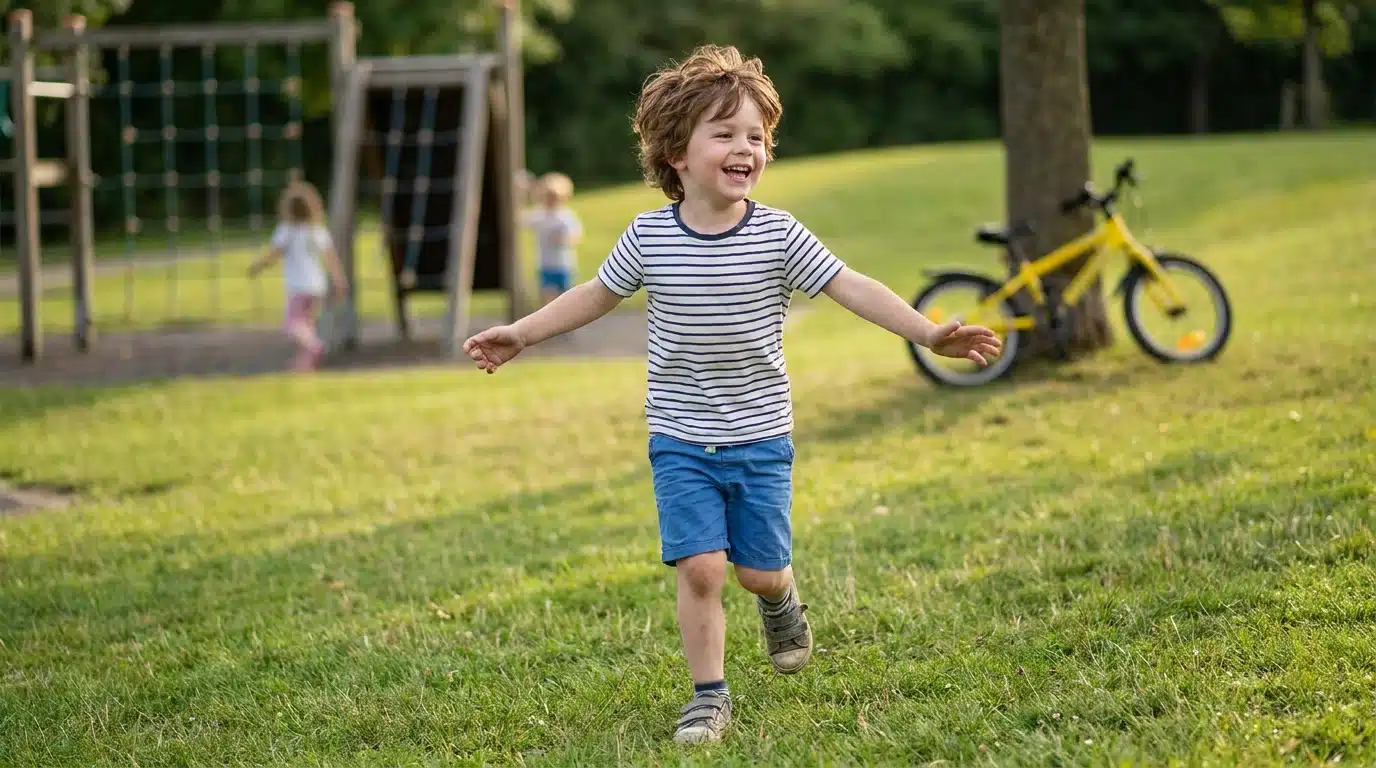
- Hop on one foot and skip with alternating feet
- Walk along a balance beam or low wall with confidence
- Catch a small ball thrown from a short distance
- Kick a ball with aim and direction
- Ride a bike, often without stabilisers by this age
- Climb frames and trees with increasing confidence
- Run, stop, start and change direction quickly
- Jump forward and land steadily on two feet
Physical activity at this age supports not just fitness, but brain development, confidence and coordination. The NHS recommends children should be active for at least 60 minutes of moderate-to-vigorous activity per day by age 5.
Fine Motor Skills
Fine motor development at age 5 is closely linked to school readiness — particularly writing and drawing. At this age, most children can:
- Hold a pencil or crayon with a mature tripod grip
- Draw a recognisable person with head, body, arms, legs and facial features
- Copy simple letters and numbers, and often write their own name
- Use scissors accurately to cut along a line
- Thread beads onto a string or lace a simple shoe
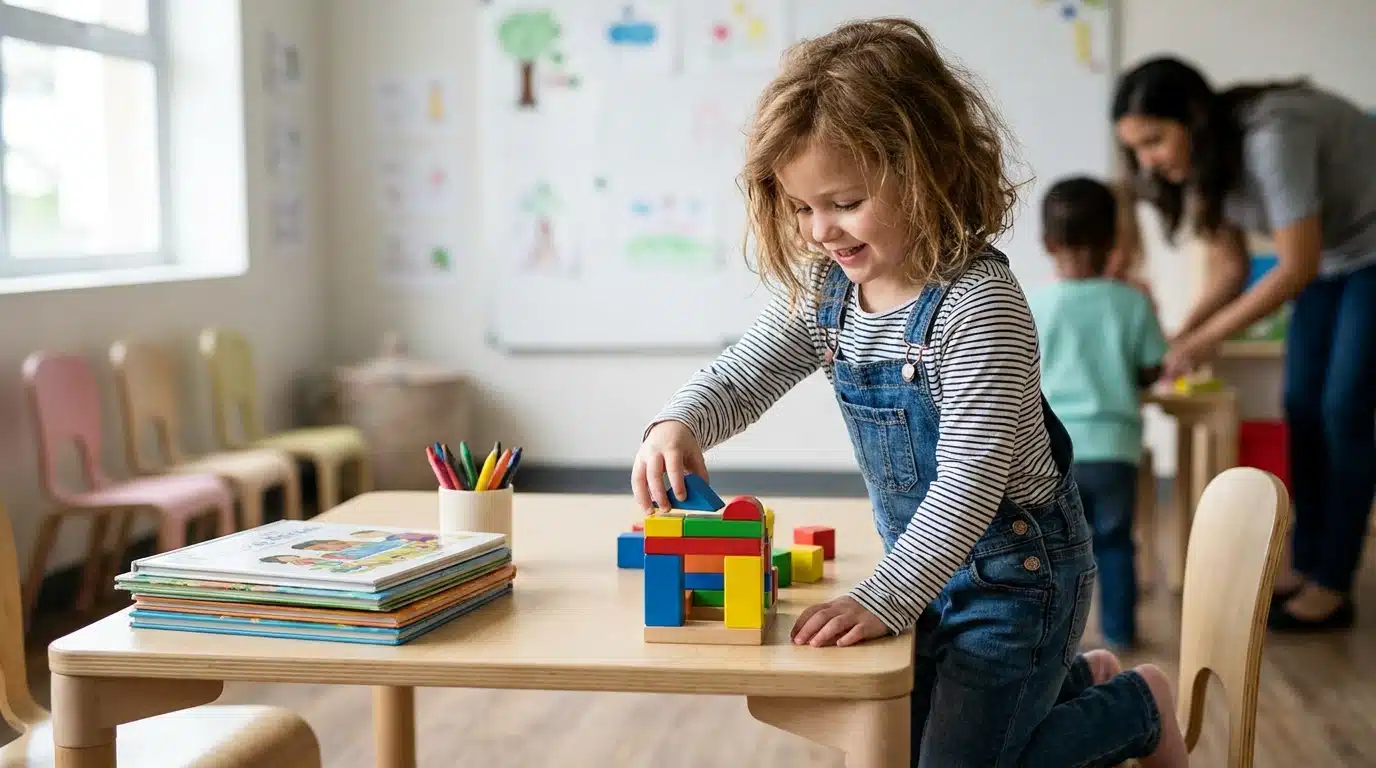
- Build structures with small bricks or construction toys
- Dress and undress independently, including buttons and simple zips
If fine motor skills feel behind, activities like playdough, threading, tearing paper and finger painting can all help build hand strength and coordination at home.
Growth at Age 5
At around age 5, children typically grow around 5–7 cm per year and gain roughly 2 kg annually. The toddler tummy has usually fully disappeared, and children often look noticeably leaner and longer than they did at three or four. Average heights in the UK at age 5 are approximately 109–112 cm for boys and 107–110 cm for girls, though there is natural variation on either side.
Communication and Language Milestones
Language development takes a huge leap between ages 4 and 5. By their fifth birthday, children typically have a vocabulary of around 2,000 words or more, and are using language in increasingly sophisticated ways — not just to name things, but to explain, reason, question and storytell.
At around 5 years old, you can expect your child to:
- Speak in sentences of 5 to 6 words or more, often much longer
- Tell a simple story with a beginning, middle and end
- Answer “why”, “when” and “how” questions
- Ask complex questions and sustain a back-and-forth conversation
- Use past, present and future tenses (mostly correctly)
- Understand and follow three-step instructions
- Know their full name, address and birthday
- Recognise their own name in writing and some familiar words
- Be understood clearly by most adults, including those outside the family
Communication and language skills underpin almost every other area of learning. Children who have strong language at age 5 are better equipped to access the curriculum, make friends and manage their emotions throughout school.
Supporting Language Development at Home
You don’t need to teach formally — everyday conversation is the most effective tool. Ask open questions (“What do you think happened next?”), expand what your child says, and encourage storytelling at bedtime. Audiobooks, nursery rhymes and word games like “I Spy” all support language development too.
Social and Emotional Development at 5 Years Old
The social world becomes much richer and more complex at age 5. Children are moving beyond parallel play into genuine cooperative friendships — and along with that comes navigating disagreements, managing big feelings and beginning to understand other people’s points of view.
At this age, most children:
- Have one or more preferred friends and show loyalty towards them
- Play cooperatively in groups, following shared rules and taking turns
- Begin to understand fairness — and feel strongly when it is violated
- Show empathy and offer comfort when others are upset
- Manage transitions (e.g. arriving at school) with increasing confidence
- Begin to regulate emotions more independently, though meltdowns still happen
- Understand the difference between intentional and accidental actions
- Start to compare themselves to others and become aware of being “good at” things

Starting school introduces a whole new social environment, and it is completely normal for children to find this tiring, overwhelming or emotionally challenging — especially in the early weeks. Consistent routines, plenty of downtime after school and open conversations about feelings all help.
Cognitive Development: What Should a 5 Year Old Know?
By age 5, children’s thinking skills have developed significantly. They are beginning to understand abstract concepts, think logically about concrete situations and use memory and attention in more deliberate ways.
A summary of cognitive skills typical at this age:
- Count reliably to 10 or beyond, and understand what numbers represent
- Recognise and name all basic colours, plus many shades (purple, orange, pink)
- Sort objects by two criteria at once (e.g. big blue shapes vs small red shapes)
- Complete simple jigsaw puzzles of 20–50 pieces
- Recall and retell simple stories, including key details
- Understand time concepts: yesterday, today, tomorrow; morning, afternoon, night
- Recognise basic letters and sounds (phonics), particularly if in Reception
- Begin to grasp cause and effect thinking
- Understand and follow simple board game rules
At age 5, children learn primarily through play and hands-on exploration. The best “cognitive workout” is still creative play — building, storytelling, art, construction and games.
⚠️ Uses NHS guidance for reference only. Does not replace professional medical advice.
School Readiness at Age 5
In England, children start Reception in the September after their fourth birthday, meaning many children begin school at just 4 years old and turn 5 during their Reception year. School readiness is therefore a topic that spans both ages 4 and 5.
There is no single checklist for school readiness — but practitioners and the NHS generally look for the following:
| Area | What to look for |
|---|---|
| Independence | Can use the toilet independently, manage their own coat and bag, and ask for help when needed |
| Communication | Can listen to an adult, follow instructions, and express their needs clearly |
| Social skills | Can take turns, share, and spend time away from parents without significant distress |
| Curiosity | Interested in exploring, learning and engaging with activities for a sustained period |
| Resilience | Can manage setbacks, try again, and recover from minor upsets |
Starting School: The Reception Year in the UK
Reception is the first year of formal education in England, Wales and Northern Ireland, and is part of Primary 1 in Scotland. Children typically start in September after their fourth birthday, meaning most are 4 or 5 years old during this year.
What Happens in Reception?
Reception is play-based and structured around the Early Years Foundation Stage (EYFS) framework. Children learn through a mix of adult-led activities and child-initiated play. Key areas include communication and language, physical development, personal and social development, literacy (phonics and early reading), mathematics, understanding the world, and expressive arts.
The Reception Baseline Assessment (RBA)
In England, all children are assessed within the first six weeks of starting Reception through the Reception Baseline Assessment. This is a short, teacher-led activity — not a test — that measures early literacy, communication and maths skills. It is used as a starting point to measure progress throughout primary school, not to label or rank children.
How to Encourage Your 5 Year Old’s Development
Five year olds learn best through play — even as they start formal schooling. The best support you can provide at home isn’t worksheets; it’s a rich, varied and stimulating environment.
Physical development
- Trips to the park, soft play, swimming and cycling support gross motor skills
- Craft activities, building sets and puzzles develop fine motor control
Language and literacy
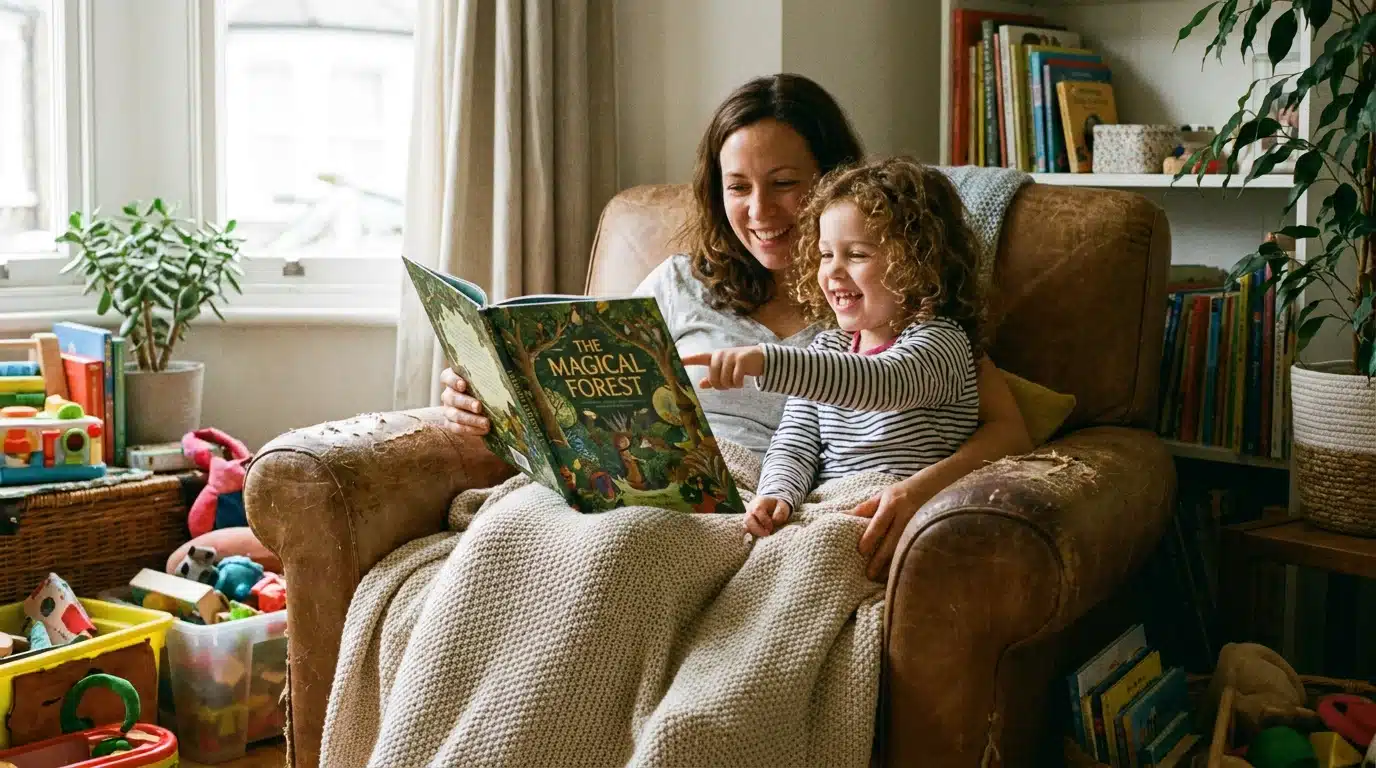
- Read together every day — mix picture books, early readers and non-fiction
- Talk about the day, make up stories, play word games and sing songs
- Visit your local library and let your child choose their own books
Cognitive and maths
- Play board games and card games that involve counting, strategy or memory
- Cook together — measuring ingredients is brilliant for early numeracy
- Encourage sorting, ordering and categorising during everyday tasks
Social and emotional
- Arrange playdates and allow children to work through conflicts independently where safe
- Name emotions and model healthy ways of managing big feelings
- Use storybooks to explore themes of friendship, fairness and feelings
As the NHS notes, parents and carers are vital in helping children reach their potential. The time you invest in talking, playing, reading and encouraging your child builds the foundations for lifelong learning.
When to Speak to Your GP or Health Visitor
Most children develop well within a broad and natural range. However, it is worth seeking advice if, by age 5, your child:
- Is very difficult to understand, even by familiar adults
- Does not use sentences of five words or more
- Struggles significantly to communicate needs or feelings in words
- Shows no interest in playing with other children
- Has significant difficulty following simple two-step instructions
- Cannot hop on one foot or manage basic physical tasks for their age
- Shows regression in previously mastered skills (toileting, speech, etc.)
- Seems extremely anxious, distressed or withdrawn beyond the first weeks of school
- Has not been assessed if you have any concerns about hearing or vision
Frequently Asked Questions
Sources & References
- NHS Cambridgeshire & Peterborough — Child Development Milestones
- Buckinghamshire Healthcare NHS Trust — Development Guide 3 to 5 Years
- NHS Just One Norfolk — Developmental Milestones
- Department for Education — Early Years Foundation Stage Framework
- Standards & Testing Agency — Reception Baseline Assessment
- WHO — Child Growth Standards
⚠️ Medical disclaimer: The content on Big Brain Child is for informational purposes only and does not constitute medical advice. Always consult a qualified healthcare professional for concerns about your child’s development or growth.